
AI READY · Industry focus

AI for Industry & Production

Machinery, quality, predictive maintenance, production planning and reporting — predictive, transparent and with clear early-warning signals.

Use case 01

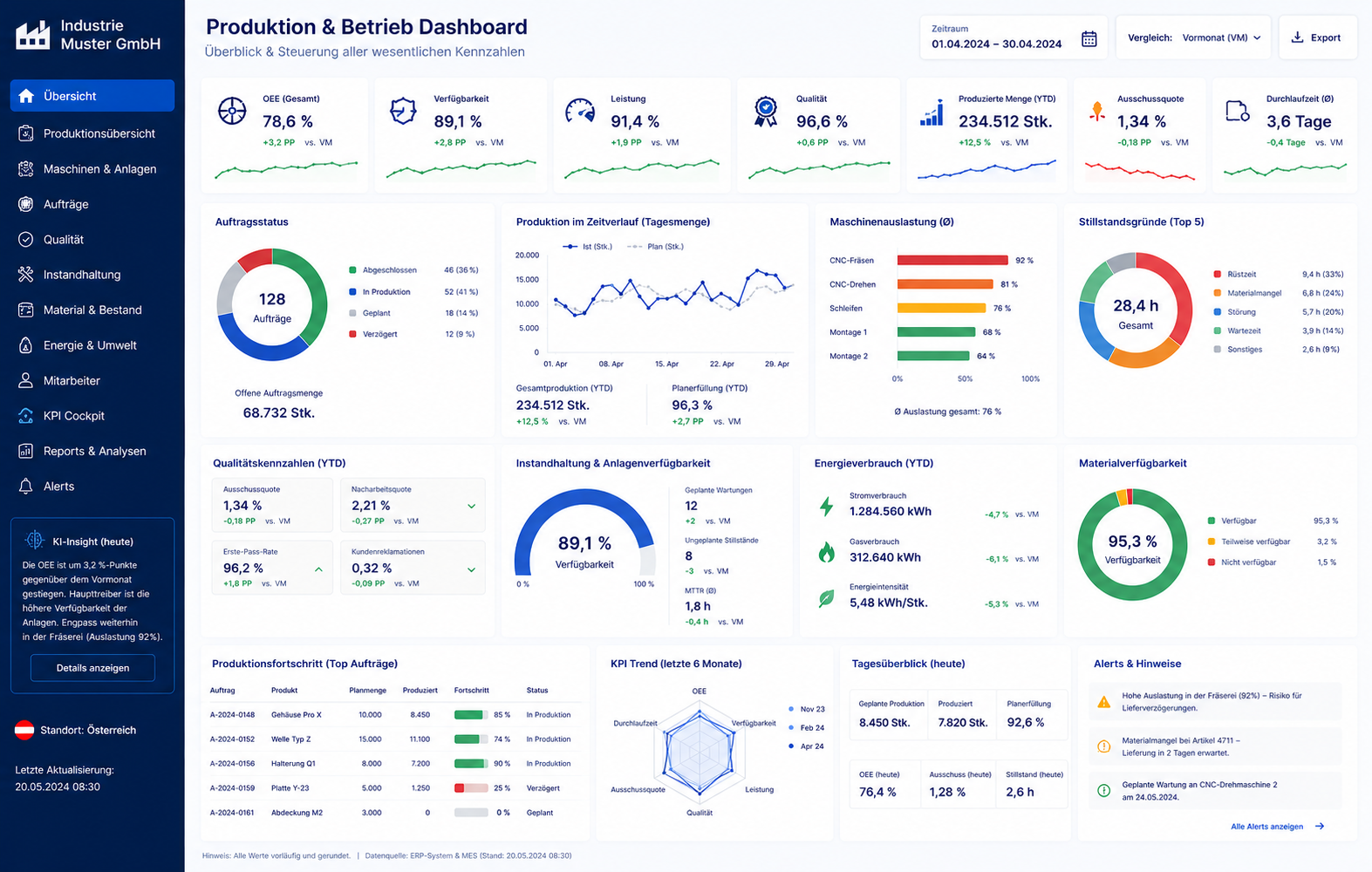
Live dashboard for Industry & Production

Equipment status, OEE KPIs, maintenance needs and energy consumption at a glance — always current, always available.

Live overview for plant and production management

The AI dashboard condenses all relevant production data into a visual overview: utilisation, machine status, maintenance dates, material flow and energy consumption are visible at a glance. Early-warning indicators surface bottlenecks, anomalies or impending failures immediately — before they become a problem.

Instead of navigating scattered SCADA and MES data, you see the state of your production in real time — and can direct your attention exactly where it is needed.

AI dashboard for production with equipment and utilisation data

How it works

In drei Schritten zum KI-Dashboard
with AI READY

1

Connect data sources

We connect MES, ERP, SCADA, sensors and maintenance systems — securely, locally and GDPR-compliant.

2

Set up dashboards

Equipment KPIs, production indicators and maintenance views are configured to your plant structure.

3

Use and refine continuously

We support and optimise continuously — the system learns alongside your production processes.

Use case 02

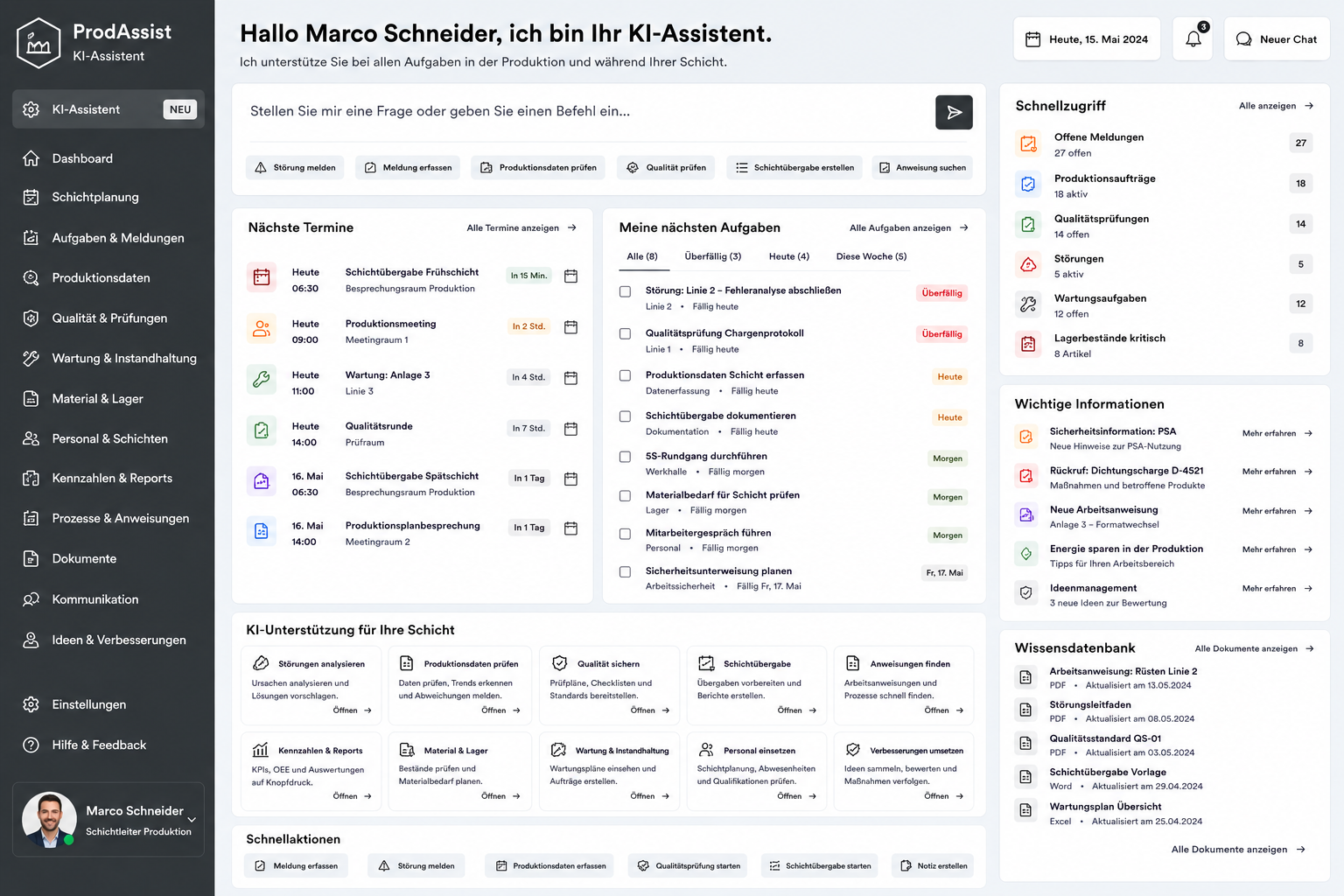
AI assistant for Industry & Production

An AI assistant that learns with your production and removes routine work from everyday plant operations.

AI assistant for production in use at the equipment

The digital colleague on the line

The AI assistant relieves your employees exactly where routine and detailed knowledge consume most of the time: machine manuals, maintenance logs and fault diagnoses are accessed directly at the workstation, shift logs are kept automatically and step-by-step instructions appear in context. Instead of leafing through manuals, your team focuses on what production is really about.

The assistant learns with your equipment and processes, knows the peculiarities of individual machines and supports operators in setup, changeover and troubleshooting. This frees up more time for value-adding activities — and less for searching and looking up.

Use case 03

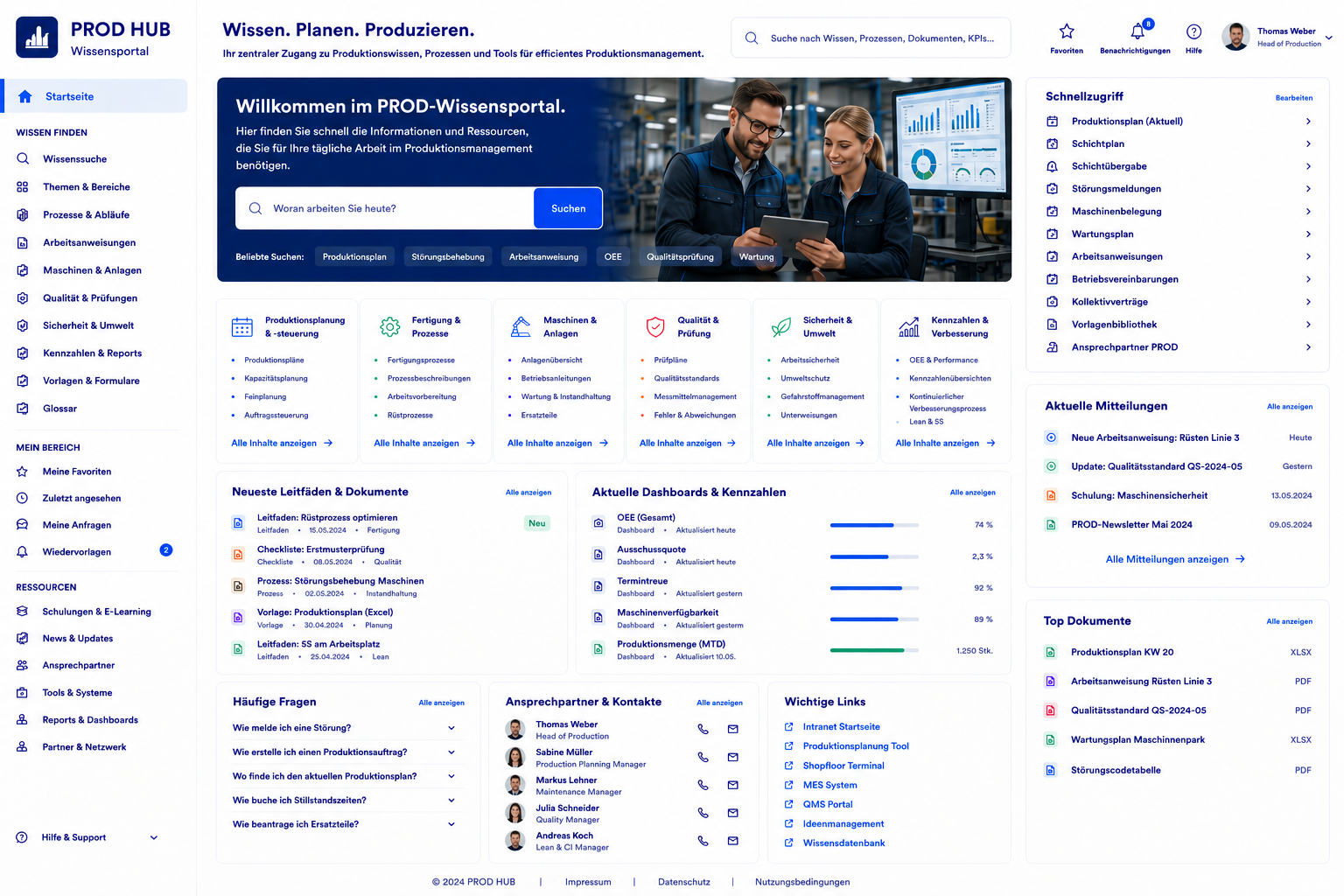
AI knowledge management for Industry & Production

All equipment manuals, procedures and experience from your plant — accessible through a single question.

Your plant's knowledge, available at any time

In addition to AI assistants, the knowledge management platform provides a central, intelligent access point to all machine manuals, procedures, maintenance logs and experience from your production. Complex questions are answered in context — based on your equipment data, technical specifications and past incidents.

Knowledge no longer stays trapped in individual heads or scattered PDFs but becomes a shared tool for the entire workforce. New employees are productive faster, senior know-how is preserved across shift changes — and research times drop to minutes.

AI knowledge management platform for production and industry

Use case 04

AI agents for Industry & Production

The AI agents shown serve as examples and inspiration. Which agents actually make sense depends on the industry, company size, processes and individual requirements – the possible applications are virtually unlimited.

In many manufacturing SMEs, the biggest effort lies not in production itself but in the planning, coordination and documentation around it: sifting through supplier emails, rescheduling orders, gathering documents and producing quality records. These ten AI agents take over exactly this recurring legwork between ERP, shop floor and customer.

1

Supply-shortage Replanner

Still manual today

Sift through supplier emails and PDFs, reconcile new dates with the production schedule in Excel, move production orders by hand and inform sales and customers by phone.

Automated with AI

Monitors the inbox for delay notifications, reads out the new delivery dates, identifies the affected production orders, calculates an alternative production sequence, updates the ERP dates and automatically informs sales, purchasing and customers.

30–40 h savings / month

Pays for itself in 9 to 12 months

ERP systems flag missing parts but cannot interpret unstructured supplier emails and PDFs or autonomously steer the downstream customer communication.

2

Special-machine Estimator (RFQ-to-BOM)

Still manual today

Experienced engineers analyse drawings and specifications, estimate times in Excel and create bills of materials by hand in the ERP, often taking hours per inquiry.

Automated with AI

Reads technical inquiries, specifications and CAD metadata, reconciles them with historical production data, creates a draft bill of materials and routing in the ERP, calculates the manufacturing costs and drafts a quote.

30–45 h savings / month

Pays for itself in 10 to 15 months

The ERP needs ready-structured data; it cannot interpret unstructured drawings and specifications to derive work steps on its own.

3

Order-confirmation Matcher

Still manual today

Transfer data from the PDF order confirmation into the ERP by hand or just file it away. Delivery delays often surface only when material is missing on the line.

Automated with AI

Reads incoming order confirmations from PDF or email, reconciles line items, prices and delivery dates with the purchase order and, where there are deviations, adjusts the production plan or requests approval from purchasing.

20–30 h savings / month

Pays for itself in 10 to 15 months

EDI interfaces are rare among SME suppliers. Standard ERPs do not understand PDFs semantically and require manual data entry.

4

Rush-order Injector

Still manual today

Sales calls the production manager, who shuffles blocks around in Excel, risks delivery delays for other customers and tells machine operators about the switch in person.

Automated with AI

Receives urgent customer inquiries, simulates the minimal rescheduling of existing orders in the capacity model, books the rush order into the ERP, updates the shift terminals and confirms a reliable delivery date to sales.

20–30 h savings / month

Pays for itself in 11 to 17 months

Standard ERP systems are rigid when it comes to scheduling; they cannot run “what-if” scenarios or communicate the impact directly.

5

Production Disruption & Escalation Agent

Still manual today

Faults are called out or reported by phone, technicians are tracked down by email, repair status is chased again and again, and the resolution is documented after the fact.

Automated with AI

Detects machine faults, gathers the causes, notifies the responsible technicians via instant messaging, drives the escalation levels when things stall, tracks implementation and fully documents the resolution in the ERP or CMMS.

25–40 h savings / month

Pays for itself in 11 to 17 months

ERP and MES systems usually only log the downtime but do not steer the dynamic, multi-channel communication and escalation chain across system boundaries.

6

Batch Documentation Packer

Still manual today

Hunt down mill certificates on network drives, scan inspection records and merge everything by hand into a single PDF for the customer.

Automated with AI

Detects completed production lots, autonomously gathers the associated material certificates, QA inspection records and machine logs, creates a customer-specific documentation PDF, links it in the ERP or DMS and sends the download link.

20–30 h savings / month

Pays for itself in 11 to 17 months

ERP and DMS systems store documents but have no agent logic to compile records from different sources per batch into a final package.

7

Shift-handover & Ticket Agent

Still manual today

Handovers happen verbally in passing or end up in illegible shift logbooks that nobody reads. Information is regularly lost in the process.

Automated with AI

Captures audio logbooks and machine downtimes at the end of the shift, filters out the core issues, automatically creates maintenance tickets for anomalies in the ERP or CMMS and generates a concise briefing for the next shift.

15–25 h savings / month

Pays for itself in 11 to 18 months

Input forms in MES or ERP are often filled in only cryptically for lack of time; the translation of free speech into structured tickets is missing entirely.

8

Scrap, Rework & Complaint Agent

Still manual today

Fill in QA slips by hand, look up batch numbers in the ERP, create rework orders manually and write complaint emails to the supplier.

Automated with AI

Processes scrap reports from the terminal (photo or voice), blocks the batch in the ERP, analyses machine and material history for the cause, creates a rework order and, for material defects, directly generates the supplier complaint (8D report).

15–25 h savings / month

Pays for itself in 11 to 18 months

ERP and CAQ systems document the defect only after manual entry but do not trigger automatic follow-on processes combining rework and a supplier 8D across system boundaries.

9

Production-release Agent

Still manual today

Foremen or work schedulers run through checklists, gather documents from network drives and clarify missing parts by phone before an order starts.

Automated with AI

Before the scheduled production start, automatically checks all hard prerequisites — material availability in the ERP, tool status, current NC programs in the DMS and QC inspection plans — and only releases the order at the terminal once everything is met.

15–25 h savings / month

Pays for itself in 11 to 18 months

The required information sits in silos across ERP, DMS and local folders; standard software cannot intelligently link these release puzzle pieces.

10

First-article Inspection Report Agent (FAI/PPAP)

Still manual today

Quality inspectors copy measurement results figure by figure from the protocols into complex customer-prescribed Excel templates and maintain customer portals by hand.

Automated with AI

Takes measurement data from quality assurance, reconciles it with the target values of the customer drawing, autonomously fills in the required FAI or PPAP form, sets the ERP status to “released” and uploads the report to the customer portal.

12–20 h savings / month

Pays for itself in 11 to 18 months

ERP systems offer standard QC charts but do not support the highly individual, document-heavy and portal-based approval processes of end customers.

Each of these agents works with your existing ERP, MES and DMS and hands decisions or complex cases seamlessly to your staff. Responsibility stays in-house, the AI handles the recurring legwork.

The figures show the potential time savings versus today's largely manual effort, along with the estimated payback period of the implementation. Guideline values, depending on company size, order structure, data quality and process maturity.

Back Get in touch