
AI READY · Service area

AI for Law Firms

Research, contracts, deadlines, client communication and document management — fast, structured and with clear case overview.

Use case 01

Live dashboard for law firms

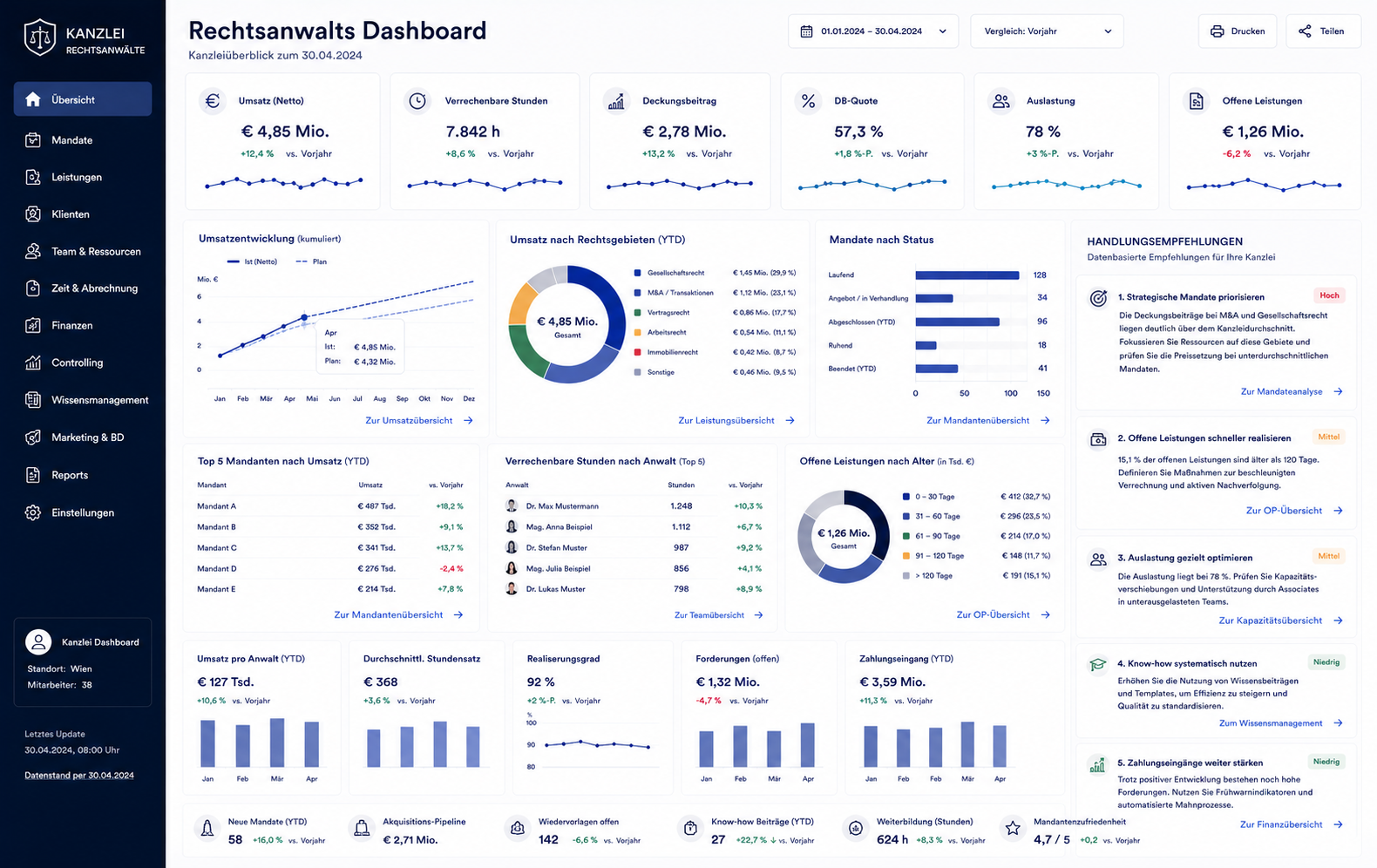
File status, open deadlines, mandates, hours, fees and compliance KPIs — condensed in one interface, always up to date.

Firm status at a glance

The AI firm dashboard condenses operational and strategic KPIs from file management, time tracking, fee billing and deadline management into one interface. Bottlenecks, critical deadlines and early-warning signals are surfaced automatically — without manual reporting work.

Firm leadership and partners see at any time where mandates, utilisation and fees stand — and can intervene before bottlenecks or missed deadlines arise.

AI dashboard for law firms – live overview of files, deadlines and fees

How it works

Three steps to the firm dashboard
with AI READY

1

Connect systems

We connect firm software, time tracking, file management and other sources — securely, locally and without data leaving your firm.

2

KPIs & early-warning rules

KPIs, deadline logic and utilisation warnings are tailored to your firm structure and mandate types.

3

Use and refine continuously

We support and optimise continuously — the dashboard grows with your firm's development.

Use case 02

AI assistant for law firms

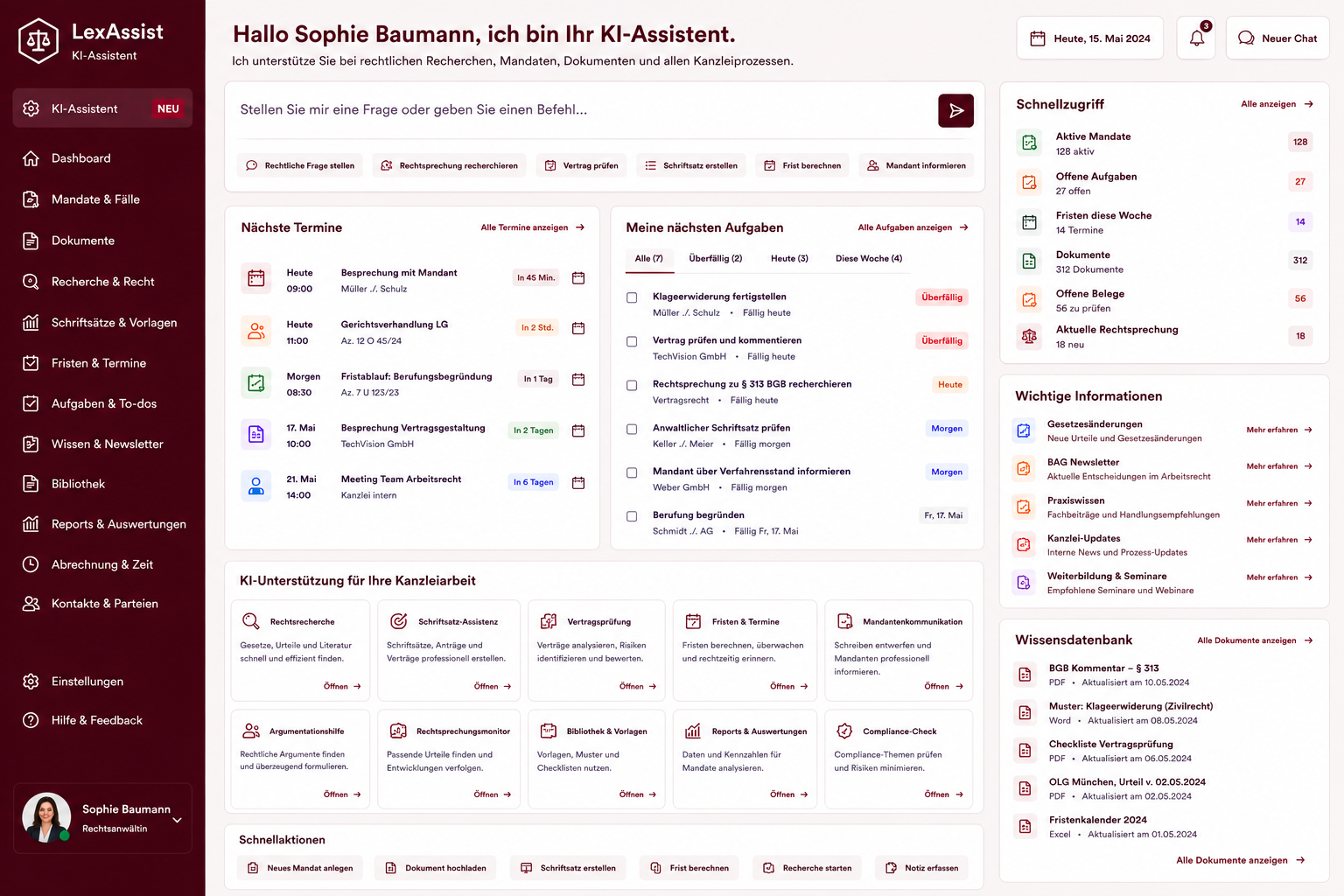
A direct contact point for legal questions, file status, deadlines and client communication — based on your own data and preserving attorney-client privilege.

Answers in seconds rather than hours

The AI assistant answers questions about file status, open deadlines, contract clauses, legal questions and mandate progress in context and traceably — based on your internal data.

Lawyers, associates and the secretariat save time on research, preparation and inquiries. Complex questions are answered in natural language, with references to the underlying files and sources.

AI assistant for law firms

Use case 03

AI knowledge management for law firms

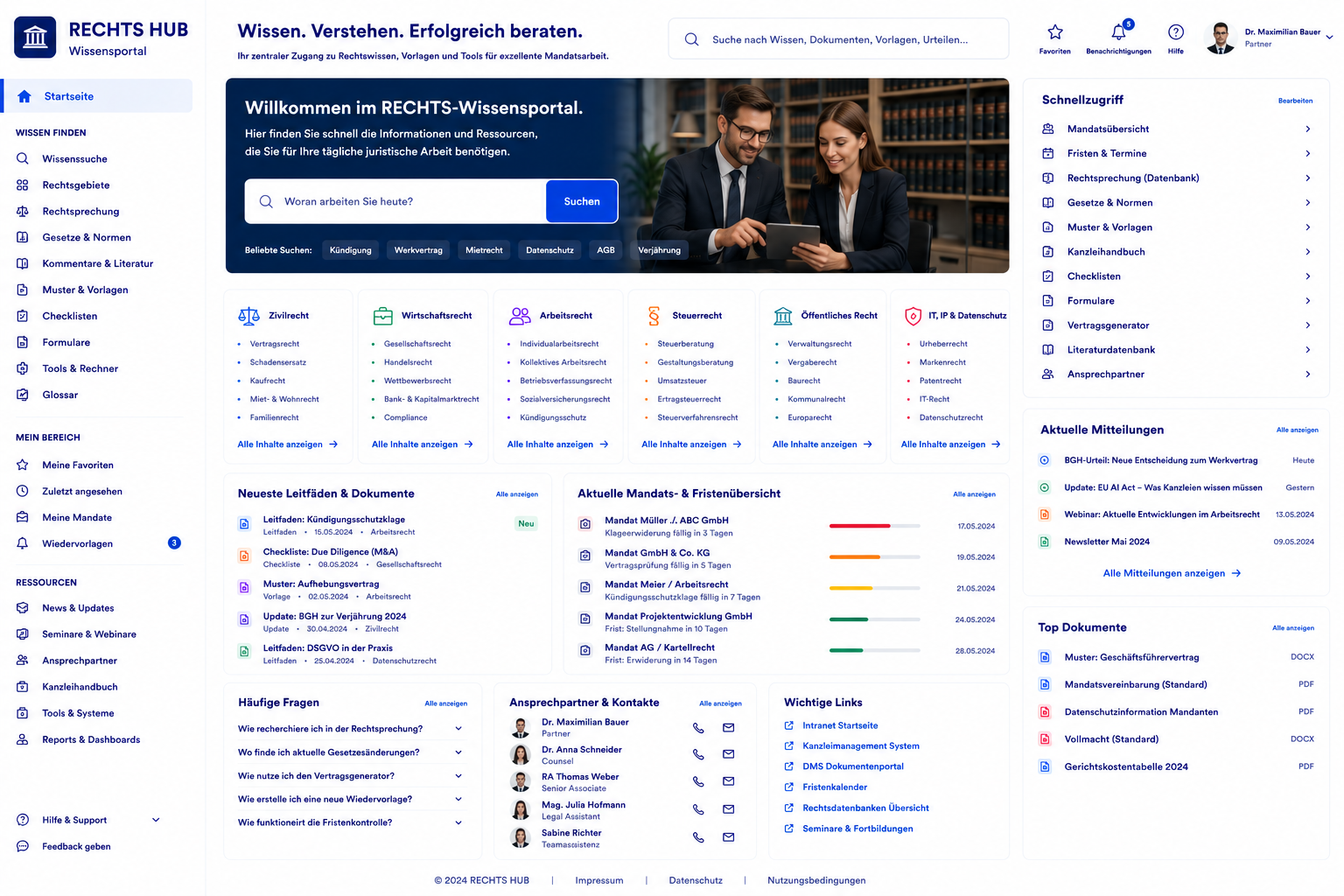
Files, templates, case law, briefs, contract patterns and experience — accessible through a single question.

Your firm's knowledge available at any time

The knowledge management platform connects files, brief templates, contract templates, case law and internal argumentation patterns into a central, intelligent access point. Anyone looking for a past case, a proven wording or specific case law finds it without long research.

Associates are productive faster, senior know-how is preserved when people leave, and consistent quality of briefs is easier to ensure.

AI knowledge management platform for law firms

Use case 04

AI agents for law firms

The AI agents shown serve as examples and inspiration. Which agents actually make sense depends on the industry, company size, processes and individual requirements – the possible applications are virtually unlimited.

In many law firms, the biggest effort lies not in the legal work itself but in gathering, meeting deadlines and coordinating: chasing documents, deriving deadlines from rulings, corresponding with insurers and authorities and keeping files complete. These ten AI agents take over exactly this recurring legwork.

1

Debt Collection & Enforcement Agent

Still manual today

Case handlers check clients' Excel lists, type lawsuit data field by field into the WebERV mask, monitor deadlines manually and create follow-up motions such as wage garnishment by hand.

Automated with AI

Monitors open items of major clients, creates dunning notices, autonomously files the claim in the order-for-payment procedure via WebERV if unsuccessful, monitors the arrival of the payment order and triggers the enforcement application at the competent district court in case of non-payment.

45–65 h savings / month

Pays for itself in 6 to 9 months

Practice software offers WebERV input masks, but the upstream data reconciliation with third-party systems, the follow-on decision claim vs. enforcement and the cross-channel communication run entirely manually.

2

WebERV Deadline Guardian & File Agent

Still manual today

Office staff sift through the WebERV return traffic, read rulings and orders individually as PDFs, calculate deadlines manually, enter them in the deadline book and drag documents into the file.

Automated with AI

Retrieves all incoming items from electronic legal communication (WebERV) daily, autonomously extracts the procedural deadlines from orders, rulings and summonses, enters them with a safety margin in the deadline calendar, links the document to the correct file and creates a draft for processing.

40–60 h savings / month

Pays for itself in 6 to 10 months

ADVOKAT and JurXpert receive the WebERV data streams, but cannot semantically interpret the unstructured reasoning and ruling texts in the attached PDFs in order to derive deadlines autonomously.

3

Client Onboarding & KYC Compliance Agent

Still manual today

Manually typing in ID data, manual ZMR and company-register queries, filling in KYC risk checklists on paper or in Word and drafting the power of attorney by hand.

Automated with AI

Processes informal initial enquiries, sends the client an encrypted capture link, pulls data from the company register and the ZMR, performs the statutory anti-money-laundering check (KYC/sanctions lists under the RAO), drafts the power of attorney and creates the file with structured master data.

35–50 h savings / month

Pays for itself in 8 to 11 months

Practice software needs ready-structured data records. It can neither interpret unstructured free-text emails nor steer the workflow of client upload, register reconciliation and risk analysis autonomously.

4

Accident & Claims Settlement Agent

Still manual today

Associates or assistants laboriously copy claim items into Excel lists, calculate pain-and-suffering days by hand using tables and draft individual claim letters manually.

Automated with AI

Handles motor third-party liability claims end-to-end: reads accident reports, police records, repair invoices and expert opinions, calculates claims (pain and suffering by daily rates, depreciation, rental car), creates the claim letter to the insurer and monitors deadlines and incoming payments.

30–50 h savings / month

Pays for itself in 8 to 13 months

Industry software offers generic document templates, but has no generative or mathematical competence to read out medical findings or repair invoices unstructured and derive claim amounts from them.

5

Land-Register & Purchase-Contract Settlement Agent

Still manual today

Manual extraction of land-register data, manual calculation of taxes in FinanzOnline masks, filling in the trust-account forms and step-by-step drafting of the contract.

Automated with AI

Handles property purchase contracts end-to-end: pulls land-register data, reads out encumbrances, drafts the purchase contract, generates the tax declaration (ImmoESt/real-estate transfer tax), creates the trust-account request at the bar association and files the land-register petition.

30–45 h savings / month

Pays for itself in 8 to 13 months

There are interfaces to the land register, but the semantic translation of encumbrances into contractual deletion obligations as well as the official tax and trust handling still require human interfaces.

6

Fee & RATG Cost-Claim Agent

Still manual today

Lawyers or experienced assistants comb through pages of files, laboriously assign tariff items under the RATG, calculate travel times and correct faulty fee notes by hand.

Automated with AI

Analyses the file after court hearings, identifies all rendered services (briefs, hearings, travel times) and autonomously creates the judicial cost claim under the Attorneys' Tariff Act (RATG) including disbursements.

25–40 h savings / month

Pays for itself in 9 to 14 months

Time-tracking modules merely add up hours. They cannot semantically assess unstructured service descriptions in the file and intelligently delineate them against the statutory tariff items of the RATG.

7

GDPR Access & Redaction Agent

Still manual today

Associates search folder structures for days, print documents, redact passages with a marker, scan them back in or use unstable PDF redaction tools.

Automated with AI

Handles access requests (Art. 15 GDPR) end-to-end: searches all digital files and emails for the person, identifies sensitive third-party data or protected correspondence, redacts these autonomously in the PDF and provides the compliant package.

20–35 h savings / month

Pays for itself in 10 to 17 months

Document management systems find search terms, but possess no legal-semantic logic to distinguish protectable third-party secrets from data subject to disclosure and to redact them automatically.

8

Witness & Party Summons Coordinator

Still manual today

Elaborate phone cascades with clients and witnesses, manual drafting of appointment confirmations and managing Excel attendance lists for the court hearing by hand.

Automated with AI

Organises the scheduling for large proceedings: analyses the affected persons, drafts personalised summons emails, requests availabilities and documents, monitors deadlines and prepares travel connections or video-conference links.

20–35 h savings / month

Pays for itself in 9 to 15 months

Practice calendars are passive tools. They cannot steer proactive, multi-stage communication loops with external, sometimes uncooperative parties autonomously.

9

Insolvency Claim Filing Agent

Still manual today

Ongoing manual checking of the insolvency register (Ediktsdatei) in the browser, manually searching and assembling invoice PDFs, manually filling in the insolvency form and WebERV transfer.

Automated with AI

Monitors the state insolvency register (Ediktsdatei) for insolvencies, identifies affected clients with open items, pulls their invoices, creates the formal claim filing, calculates the insolvency fee, files it via WebERV at the insolvency court and monitors the examination hearing.

20–30 h savings / month

Pays for itself in 11 to 16 months

There is no proactive matching logic between the state insolvency register, the client data and an automated judicial filing chain.

10

Legal-Expenses-Insurance Coverage Agent

Still manual today

Assistants fill in the insurers' online forms by hand, type in the facts, chase case handlers by phone and check rejection letters manually for their legitimacy.

Automated with AI

Takes over communication with legal-expenses insurers: reads out the facts, analyses the policy terms (AVB) for coverage exclusions, formulates the coverage request with legal reasoning, monitors the approval and autonomously follows up on rejections.

15–30 h savings / month

Pays for itself in 10 to 19 months

Practice software offers at most a static cover-letter macro. It can neither check policy terms in substance nor adapt the legal argument to enforce coverage autonomously.

Each of these agents works with your existing practice software (ADVOKAT, JurXpert …) as well as WebERV, the company and land registers and the ZMR, and hands complex cases seamlessly to the lawyer or associate. The mandate stays in the firm, the AI handles the legwork.

The figures show the potential time savings versus today's largely manual effort, along with the estimated payback period of the implementation. Guideline values, depending on firm size, file and deadline volume, data quality and process maturity.

Back Get in touch