
AI READY · Service area

AI for Retail & E-Commerce

Assortment, pricing, online shop, customer service, marketing and logistics — data-driven, fast and with clear margin transparency.

Use case 01

Live dashboard for Retail & E-Commerce

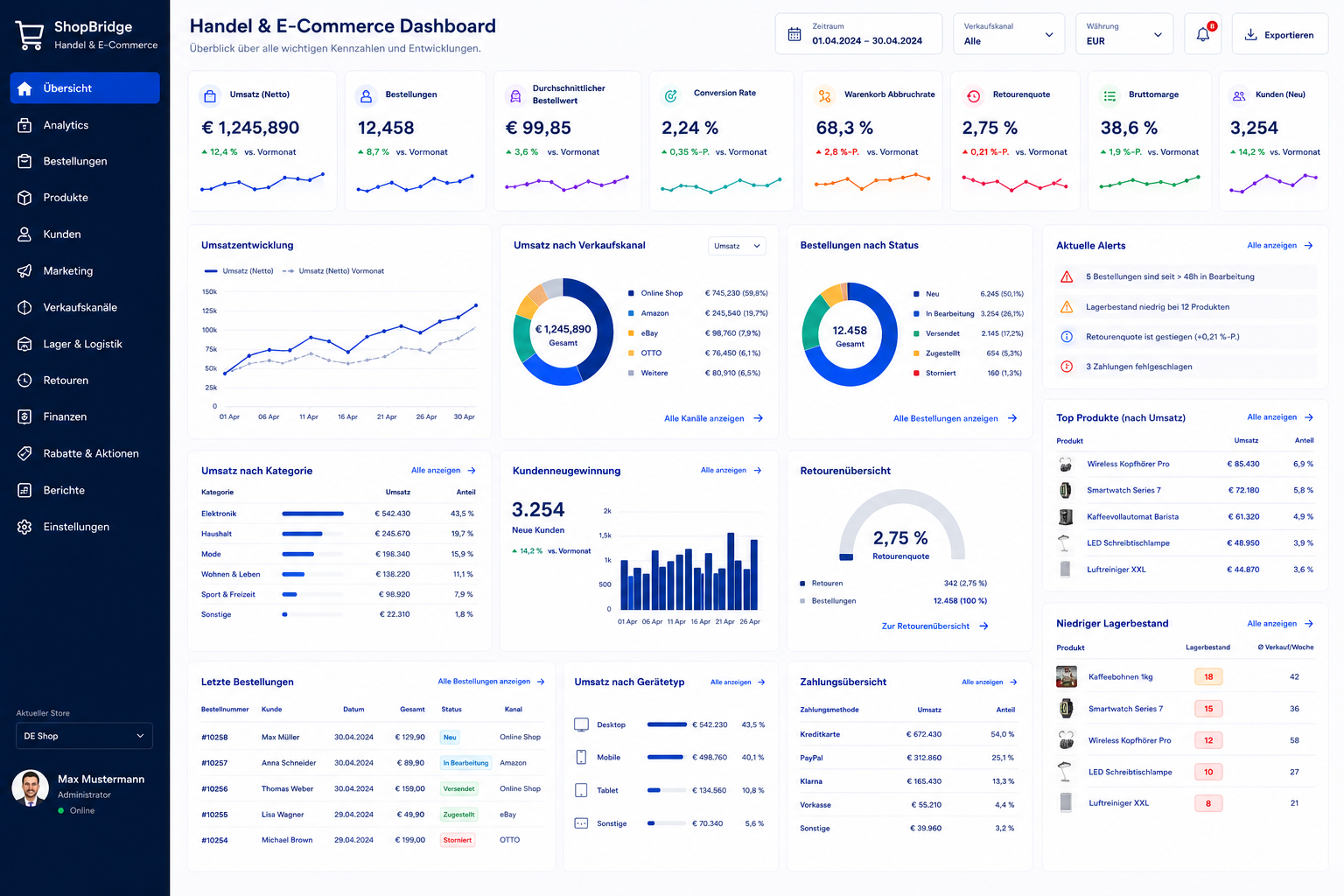
Revenue, inventory, orders, returns, channels and marketing performance — condensed in one interface, always up to date.

All retail KPIs at a glance

The AI retail dashboard condenses operational and strategic KPIs from shop, ERP, marketplaces, warehouse and marketing into one interface. Bestsellers, slow movers, return rates and early-warning indicators are surfaced automatically — without manual reporting work.

Management, purchasing, sales and marketing see at any time where the business stands — and can intervene exactly where needed.

AI dashboard for Retail and E-Commerce – live overview of revenue, inventory and channels

How it works

Three steps to the AI retail dashboard
with AI READY

1

Connect systems

We connect shop system, ERP, warehouse, marketplaces and other data sources — securely, locally and without data leaving your company.

2

Configure KPIs & reports

KPIs, reports and early-warning rules are tailored to your assortment logic and sales channels.

3

Use and refine continuously

We support and optimise continuously — the dashboard grows with your processes and requirements.

Use case 02

AI assistant for Retail & E-Commerce

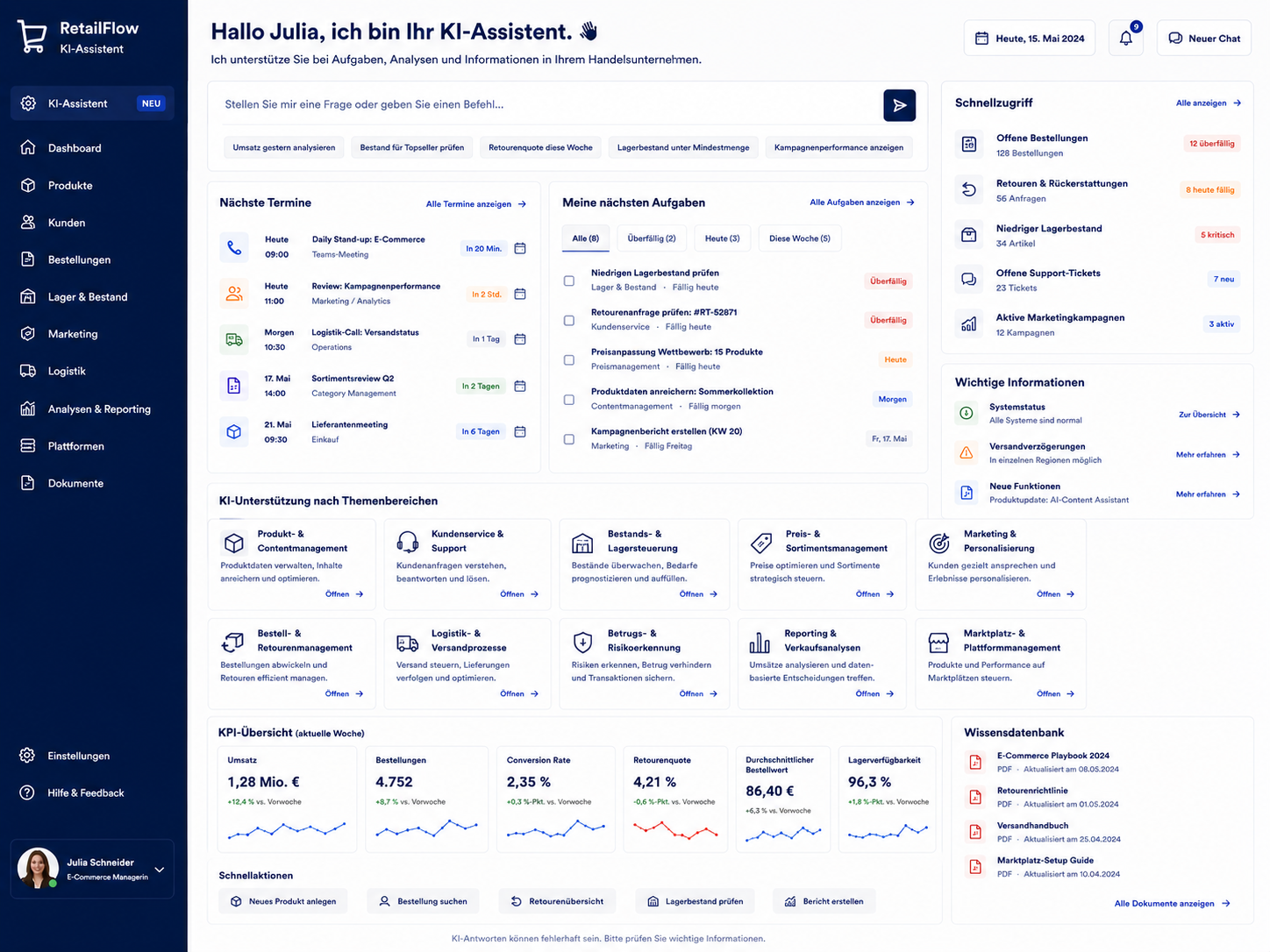
A direct contact point for assortment, inventory, orders and customer inquiries — based on your own product and sales data.

Answers in seconds rather than hours

The AI assistant answers concrete questions about products, inventory, open orders, returns or customer data — context-aware and traceable, based on your shop, ERP and marketplace data.

Sales, customer service and purchasing save time on research, inquiries and preparing analyses. Complex questions are answered in natural language — with references to the underlying data and transactions.

AI assistant for Retail and E-Commerce

Use case 03

AI knowledge management for Retail & E-Commerce

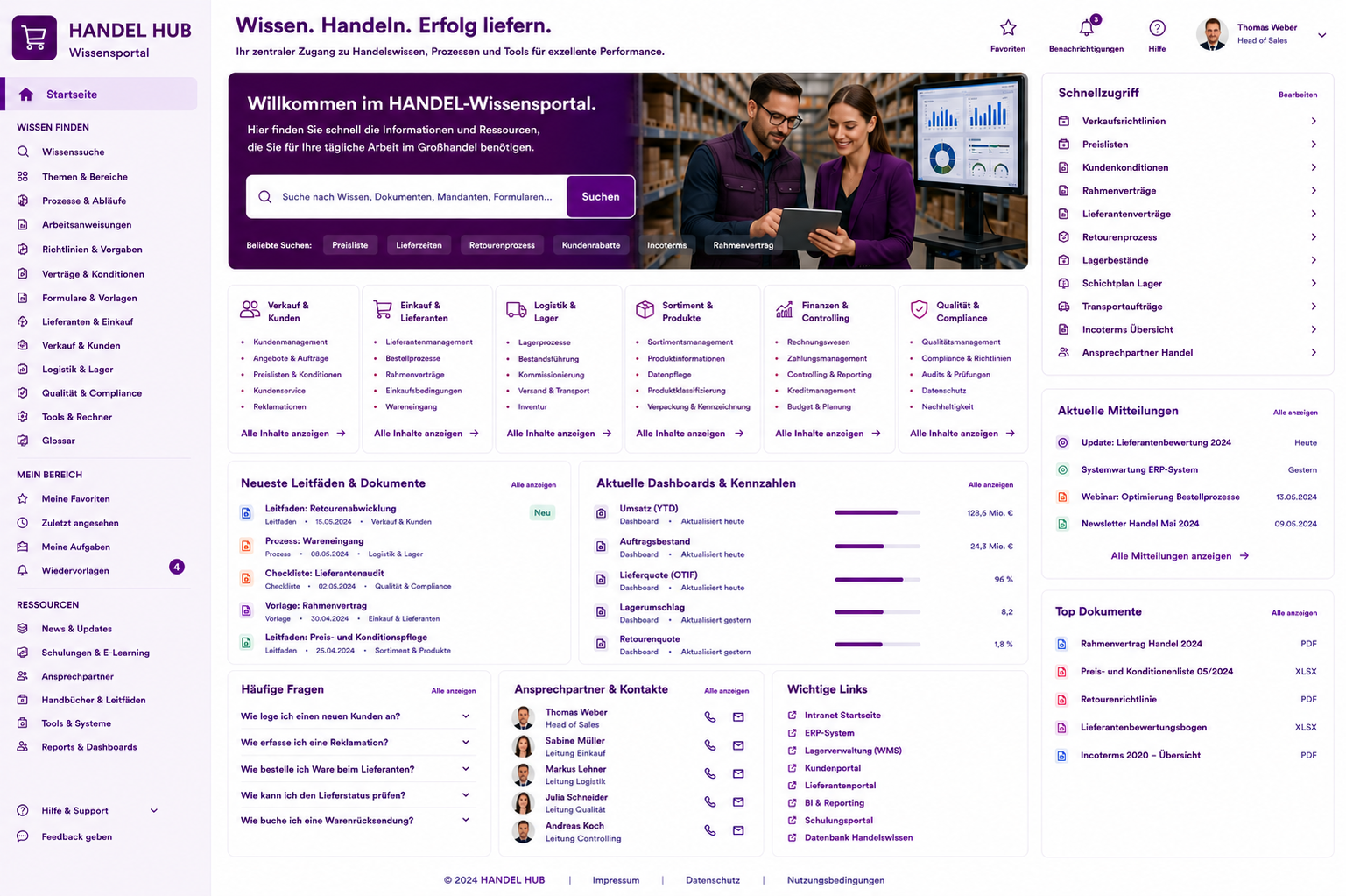
Product information, supplier documents, process descriptions, policies and experience — accessible through a single question.

Your company's retail knowledge available at any time

The knowledge management platform provides an intelligent, central access point to all retail-relevant documents: product data sheets, supplier contracts, assortment policies, marketing briefs, internal guidelines and experience from past campaigns and seasons.

Research times drop to minutes, new employees become productive faster, and senior know-how is preserved when people leave. Knowledge becomes a shared tool for purchasing, sales, marketing and service.

AI knowledge management platform for Retail and E-Commerce

Use case 04

AI agents for Retail & E-Commerce

The AI agents shown serve as examples and inspiration. Which agents actually make sense depends on the industry, company size, processes and individual requirements – the possible applications are virtually unlimited.

In many retail and wholesale companies, the biggest effort lies not in selling itself but in capturing and coordinating: typing in orders, chasing delivery dates, handling complaints and following up with suppliers. These ten AI agents take over exactly this recurring legwork.

1

B2B Order Ingestion Agent

Still manual today

Sales staff read every email, look up article numbers in the ERP, type order lines one by one and query unclear points manually by email or phone.

Automated with AI

Monitors the sales inbox for incoming B2B orders, captures the customer's intent and quantities, maps chaotic article descriptions to internal article numbers, checks availability, creates the order autonomously in the ERP and sends the order confirmation.

45–65 h savings / month

Pays for itself in 6 to 9 months

Standard ERPs do support EDI interfaces, yet smaller and mid-sized B2B customers still send unstructured PDFs and emails that no ERP can read without AI logic.

2

Supplier Delivery-Delay & Notification Agent

Still manual today

Buyers manually check Excel lists of open orders, write dunning emails by hand, type new dates into the ERP and call sales so they inform the affected customers.

Automated with AI

Monitors open purchase orders in the ERP, autonomously contacts the supplier when a delay looms, interprets their unstructured reply, corrects the delivery date in the ERP and proactively informs affected customers and sales teams.

40–55 h savings / month

Pays for itself in 7 to 10 months

Inventory systems manage delivery dates and send rigid dunning notices, but can neither understand unstructured supplier replies nor adjust the downstream logistics chain autonomously.

3

End-to-End Returns & Complaints Agent

Still manual today

Customer service sifts through complaint emails, assesses damage visually, creates return documents by hand, writes individual customer emails and laboriously claims credit notes from the supplier.

Automated with AI

Processes incoming complaints including damage photos, assesses the case against rules, creates the return or credit note in the ERP, triggers the replacement delivery and at the same time generates a notice of defect including photo evidence to the upstream supplier.

35–50 h savings / month

Pays for itself in 8 to 11 months

ERP and CRM systems only document a complaint once it has been structured; they neither validate defects in photos nor steer the two-sided correspondence with customer and supplier.

4

Freight-Cost Audit & Logistics Agent

Still manual today

Staff in logistics or accounting spot-check multi-page freight invoices against consignment notes and Excel tariff tables — error-prone and often neglected.

Automated with AI

Collects incoming carrier and parcel-service PDFs, reconciles every line item (base price, diesel floater, toll, surcharges) with the ERP delivery data and the stored tariff matrix, disputes deviations with the carrier and releases correct invoices.

30–45 h savings / month

Pays for itself in 8 to 12 months

The classic 3-way match in the ERP fails for freight costs, because logistics invoices contain dynamic, unstructured ancillary charges that cannot be modelled as standard items.

5

Supplier Conditions & Bonus Monitoring Agent

Still manual today

Buyers keep shadow Excel lists of agreed annual bonuses, add them up laboriously at year-end and, for lack of control, regularly miss rebates they are entitled to.

Automated with AI

Analyses purchasing-contract PDFs for complex, retroactive tiered and annual bonuses, monitors the cumulative purchasing volume in the ERP, alerts when thresholds are reached and autonomously creates the debit note to the supplier at year-end.

25–40 h savings / month

Pays for itself in 9 to 14 months

ERP systems map standard prices and direct discounts well, but cannot automatically extract and monitor textually agreed, time-deferred annual or volume bonuses from contracts.

6

Product Onboarding & Content Enrichment Agent

Still manual today

Product managers spend days copying columns from supplier Excels into master tables, rewriting texts by hand, assigning images and fixing CSV import errors in the online shop manually.

Automated with AI

Processes unstructured supplier catalogues (Excel, PDFs, image folders), extracts technical attributes, translates descriptions, writes SEO-optimised, on-brand shop texts and loads the validated data via API into the ERP/PIM.

25–40 h savings / month

Pays for itself in 9 to 14 months

PIM and ERP systems only offer rigid input masks; they lack the semantic intelligence to transform, enrich and generate text from unstructured third-party data autonomously.

7

Marketplace Health & Listing Compliance Agent

Still manual today

E-commerce managers log into various marketplace back ends every day, analyse cryptic error messages, correct data manually and submit reactivation requests via web forms.

Automated with AI

Continuously monitors the listings on external marketplaces, detects listing blocks, price errors or compliance suspensions, analyses the error message, corrects it in the source system or autonomously uploads the required document.

20–35 h savings / month

Pays for itself in 9 to 16 months

Multichannel tools only push data rigidly in one direction; if a marketplace blocks a listing over a policy change, they can neither interpret nor fix the error.

8

Tender & RfQ Screening Agent

Still manual today

Key account managers search portals, read pages of tender PDFs, compare specifications with the product catalogue by hand and type calculations laboriously into Excel.

Automated with AI

Scans public procurement portals and incoming RfQs, analyses the required specifications, matches them semantically against the own assortment, calculates initial prices respecting minimum margins and prepares the quote in the ERP.

20–30 h savings / month

Pays for itself in 11 to 17 months

CRM and sales modules can write quotes, but can neither search tender platforms autonomously for matching projects nor match an unstructured requirement description to the assortment.

9

Stock-Discrepancy & Clarification Agent

Still manual today

Warehouse managers and planners pore over old delivery notes, search the supplier email traffic and check posting logs to find out why stock is missing.

Automated with AI

Triggered automatically on a reported stock discrepancy, reconstructs the item history in the ERP (goods receipts, delivery notes, cancellations), searches supplier emails for unposted corrections and prepares the correction journal including a root-cause report.

15–25 h savings / month

Pays for itself in 11 to 19 months

WMS and ERP systems log stock shortfalls, but possess no cross-system analysis logic to draw on unstructured communication for root-cause investigation.

10

B2B Quote Follow-up & Negotiation Agent

Still manual today

Sales reps rarely manage to follow up on all open quotes consistently, conduct negotiations individually by email and re-edit changed quotes from scratch in the ERP every time.

Automated with AI

Monitors open quotes in the ERP, follows up by email when feedback is missing, reads the reply, autonomously checks the stored minimum margins and drafts a modified counter-offer directly from the ERP.

15–25 h savings / month

Pays for itself in 11 to 19 months

CRM systems offer automatic reminder emails, but cannot interpret unstructured negotiation objections, validate margin floors and renegotiate quotes autonomously.

Each of these agents works with your existing ERP, web shop and marketplaces and hands complex cases seamlessly to sales or purchasing. The customer relationship stays in-house, the AI handles the legwork.

The figures show the potential time savings versus today's largely manual effort, along with the estimated payback period of the implementation. Guideline values, depending on assortment size, order and complaint volume, data quality and process maturity.

Back Get in touch